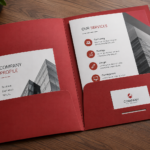
Real estate signs need to be easy to read, practical to place, and suited to the property being marketed. Whether you are preparing a residential listing, commercial property, open house, or leasing campaign, choosing the right sign size and material helps your message look professional and stay visible.
For agents and brokerages, the right sign is not just about looking good. It affects how quickly people understand the listing, how visible the property is from the road, and how easy it is to guide buyers to an open house or showing.
Need real estate signs printed in Hamilton or Burlington? Request a real estate sign quote.
Common real estate sign sizes
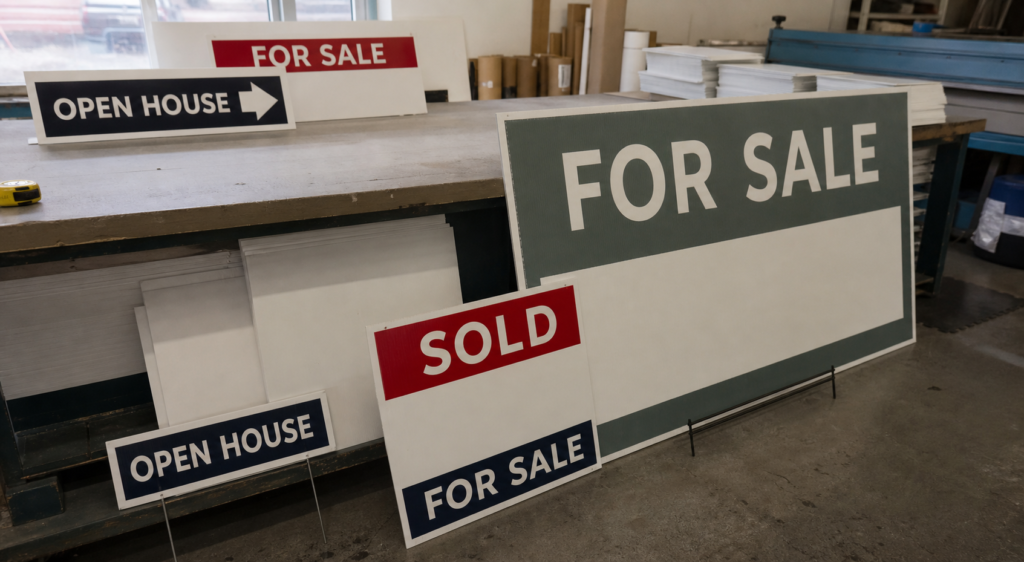
Real estate signs come in several standard sizes, but the best size depends on where the sign will be placed, how far away people need to read it, local sign rules, how it will be mounted, and the type of listing being promoted.
A small front lawn sign for a residential property has different needs than a large commercial leasing sign, a directional open house arrow, or a sales centre display.
Common sign size examples
| Sign type | Common sizes | Best used for |
|---|---|---|
| Lawn signs | 18 × 24 in, 24 × 24 in, 24 × 36 in | Residential listings, for sale signs, sold signs, for lease signs |
| Hanging signs | 24 × 18 in, 24 × 24 in, 24 × 36 in | Post mounted residential signs, premium listings, brokerage branded signs |
| Open house signs | 18 × 24 in, 24 × 18 in, 24 × 24 in | Weekend open houses, temporary event signage |
| Directional signs | 12 × 18 in, 18 × 24 in | Arrows, parking signs, route guidance |
| Sign riders | 6 × 24 in, 6 × 30 in, 8 × 24 in | Sold, conditional, coming soon, open house, price updates |
| Larger property signs | 32 × 48 in, 36 × 48 in, 48 × 48 in | Large lots, land listings, development sites |
| Commercial real estate signs | 48 × 48 in, 48 × 96 in, custom sizes | For lease, for sale, retail plazas, industrial properties, development sites |
If the sign will be placed in Hamilton, agents and property owners should review the City of Hamilton sign bylaw before installing larger, mounted, or long term outdoor signs. For Burlington listings, the City of Burlington sign permit information is helpful when planning larger signs, portable signs, or signs that may need approval.
How to choose the right size
A good rule is simple: the farther away the viewer is, the larger and simpler the sign should be.
For residential listings
Most residential signs need to work from the street, sidewalk, or a passing car. The sign should make the main message clear first, then show the agent or brokerage details.
Good examples:
- For Sale
- Sold
- Coming Soon
- For Lease
- Open House
- Agent name and phone number
For commercial listings
Commercial real estate signs often need to work from a greater distance. Drivers may only have a few seconds to read the sign, so the message needs to be larger, clearer, and less crowded.
Good examples:
- For Lease
- Retail Space Available
- Office Space Available
- Industrial Unit For Lease
- Development Opportunity
- Call or website
For open house signs
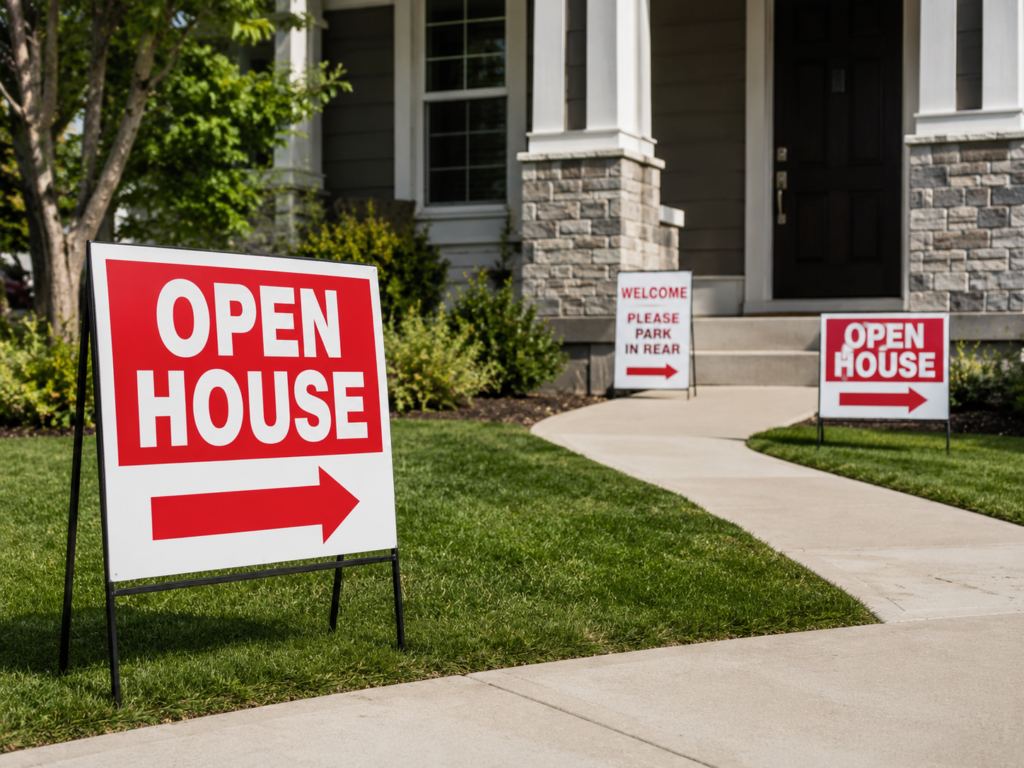
Open house signs are more about direction than full information. The goal is to help someone find the property quickly.
The most important elements are:
- Open House
- Directional arrow
- Address or area if needed
- Agent or brokerage branding
- Time if space allows
For larger signs or signs attached to a property, it may also be worth checking Ontario’s general guidance on when a sign permit may be required.
Real estate lawn signs
Real estate lawn signs are the most common temporary listing signs for residential properties. They are used to promote homes, condos, townhouses, small commercial units, rental properties, and short term listing campaigns.
Most lawn signs are placed near the front of the property where they can be seen from the road or sidewalk. They are usually printed on outdoor friendly material and installed using stakes, frames, or posts depending on the sign style.
For standard real estate listing signs, lawn signs and coroplast signs are often the most practical choice because they are lightweight, affordable, and suitable for short term outdoor use.
Common uses for real estate lawn signs
| Use | Message examples | Notes |
|---|---|---|
| Active listing | For Sale, For Lease | Should be clear from the street |
| New listing | Just Listed, Coming Soon | Good for early interest before showings |
| Status update | Sold, Conditional | Often handled with riders |
| Rental listing | For Rent, Leasing Now | Useful for residential and small commercial properties |
| Agent branding | Agent name, brokerage, phone number | Keep readable and uncluttered |
What makes a good lawn sign?
A strong lawn sign is not overloaded. It should communicate the main listing message first, then support it with the agent or brokerage information.
Good lawn sign hierarchy
- Main message
Example: For Sale, Sold, Coming Soon - Property or listing detail
Example: Detached Home, Commercial Unit, Executive Townhome - Agent or brokerage name
- Phone number or website
- Optional QR code
Lawn sign example layout
Top area:
- Brokerage logo or agent branding
Middle area:
- Large message: For Sale
Bottom area
- Agent name
- Phone number
- Website or QR code
This type of layout works because the main message is readable first. Someone driving by does not need to process too much information.
Open house and directional signs
Open house signs and directional signs are temporary signs used to guide people to a showing, event, property tour, or sales office. They are especially useful in residential neighbourhoods, condo areas, subdivisions, rural properties, plazas, and streets where the listing is not immediately visible from a main road.
If you are promoting a listing campaign, it is usually better to think of open house signage as a small system instead of one sign. A single sign on the lawn may not be enough if visitors need help finding the property.
Print Factory Ink supports agents and brokerages with real estate printing and signs for listings, open houses, property marketing, brochures, flyers, and related print materials.
Common open house sign types
| Sign type | Purpose | Example message |
|---|---|---|
| Open house sign | Announces the event | Open House Today |
| Directional arrow | Guides drivers or walkers | Open House → |
| Parking sign | Helps manage arrival | Visitor Parking |
| Welcome sign | Creates a professional arrival point | Welcome to the Open House |
| Feature sign | Highlights property selling points | 4 Bedroom Home, Finished Basement |
| Agent sign | Reinforces branding | Hosted by Agent Name |
Where open house signs are usually placed
Open house signs work best when they are placed at decision points.
Examples:
- Main road entrance
- Neighbourhood entrance
- First turn toward the property
- Corner before the listing
- Driveway or walkway
- Building lobby or elevator area
- Parking area
Design tips for open house signs
Open house signs need to be readable from a car or sidewalk. This means the design should be simple and direct.
Keep the text short
Use:
- Open House
- Today
- 2 to 4 PM
- Arrow
- Agent name
- Phone number if needed
Avoid:
- Long property descriptions
- Too many photos
- Small paragraphs
- Multiple phone numbers
- Too many colours
Use strong arrows
Directional signs should make the arrow obvious. If the arrow is the reason for the sign, it should be one of the largest elements on the design.
Print enough signs
For a typical residential open house, many agents need more than one sign.
Example sign set:
| Location | Suggested sign |
|---|---|
| Main street | Open House arrow sign |
| Neighbourhood entrance | Directional sign |
| Street corner | Directional sign |
| Property lawn | Open House welcome sign |
| Driveway or entrance | Welcome or parking sign |
Sign riders and message panels
Sign riders are smaller message panels that attach above, below, or onto a main real estate sign. They are useful because they let you update the message without reprinting the entire sign.
For example, instead of printing a brand new lawn sign when a property sells, you can add a “Sold” rider to the existing sign. This keeps the main sign reusable and makes the listing status easy to update.
Common real estate sign rider messages
| Rider message | When to use it |
|---|---|
| Sold | After the property sells |
| Conditional | When the sale is conditional |
| Coming Soon | Before the listing is fully active |
| Open House | For showings and weekend events |
| Price Update | When pricing changes |
| For Lease | For rental or commercial leasing signs |
| Agent Name | For team or brokerage templates |
| Phone Number | When contact details need to be prominent |
| Custom Message | For special campaigns or unique listings |
Why riders are useful
Riders are practical for agents, teams, and brokerages that reuse sign systems across multiple listings.
They help with:
- Updating listing status quickly
- Reducing the need to reprint the full sign
- Keeping branding consistent
- Adding temporary messages
- Supporting different campaign stages
Example rider combinations
Residential listing
- Main sign: For Sale
- Rider: Coming Soon
- Later rider: Sold
Open house campaign
- Main sign: Open House
- Rider: Sunday 2 to 4 PM
Commercial property
- Main sign: For Lease
- Rider: Retail Space Available
Design tips for sign riders
Riders are smaller than the main sign, so the message needs to be short.
Good rider text:
- Sold
- Conditional
- Open House
- Coming Soon
- New Price
- For Lease
Avoid putting too much information on a rider. If the text is too small, it will not be useful from the road.
Common real estate sign materials
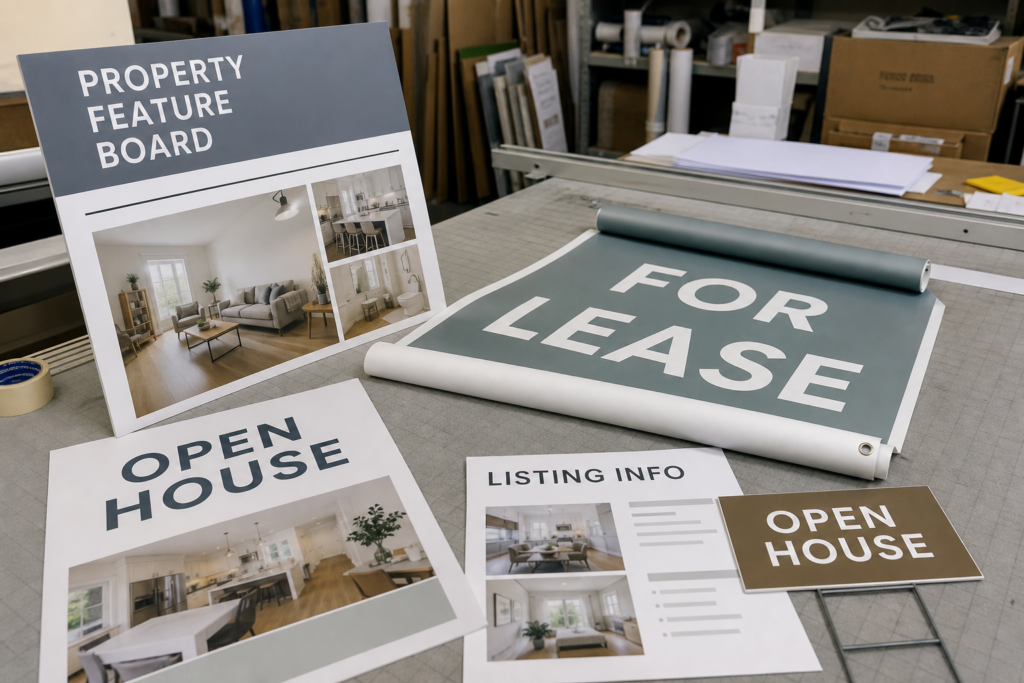
The material matters as much as the size. A real estate sign has to match the location, how long it will be used, how it will be installed, and how professional the listing needs to look.
For most real estate printing, the material choice usually comes down to one question:
Will this be used outdoors temporarily, indoors for presentation, or as a larger display?
Common material options for real estate signs
| Material | Best for | Typical use | Notes |
|---|---|---|---|
| Coroplast | Temporary outdoor signs | Lawn signs, open house signs, directional signs | Lightweight, practical, cost effective |
| Rigid sign board | More durable outdoor or mounted signs | Commercial listings, property signs, leasing signs | Better for longer campaigns or larger signs |
| Foam board | Indoor presentation | Sales centres, listing presentations, brokerage offices | Clean and professional indoors, not for outdoor weather |
| Banner material | Larger outdoor or indoor promotion | Commercial properties, developments, open house events | Good when you need size and visibility |
| Mounted boards | Office or sales centre displays | Presentation boards, project boards, feature boards | Useful for polished indoor marketing |
Quick material guide
| If you need this | Usually choose |
|---|---|
| A short term lawn sign | Coroplast |
| Open house arrows | Coroplast |
| Indoor property presentation board | Foam board or mounted board |
| A large “For Lease” sign on a fence | Banner or rigid sign |
| A commercial real estate sign facing traffic | Rigid sign board |
| A sales centre display | Mounted board or foam board |
| A large temporary development promotion | Banner material |
How long will the sign be used?
This is one of the easiest ways to choose the right material.
A few days to a few weeks
Coroplast is usually enough. This works well for open houses, short term listing signs, directional signs, and temporary campaign signs.
A few weeks to a few months
Coroplast may still work, but rigid signs or banners can be better if the sign is larger, exposed to wind, or placed in a high visibility location.
Several months or repeated use
A more durable material usually makes sense. This is especially true for commercial listings, leasing signs, development marketing, and sales centre displays.
Indoor versus outdoor use
Outdoor signs need to handle weather, wind, sunlight, and installation. Indoor signs are more about presentation quality.
Outdoor real estate signs
Good for:
- Residential lawn signs
- Open house signs
- Directional signs
- Commercial property signs
- For lease signs
- Development signs
Outdoor signs should be easy to read, durable enough for the campaign, and suitable for the mounting method.
Indoor real estate signs
Good for:
- Listing presentation boards
- Sales centre displays
- Broker open house displays
- Office signage
- Condo presentation materials
- Feature boards
Indoor signs can use materials that look cleaner up close, such as foam board or mounted boards.
When to use coroplast signs
Coroplast is one of the most common materials for real estate signs because it is lightweight, practical, and suitable for temporary outdoor use.
It is often the best choice when agents need signs quickly, need multiple signs for one listing, or need affordable signage for open houses and directional routes.
For most residential listing campaigns in Hamilton, Burlington, Stoney Creek, Ancaster, Dundas, Waterdown, and nearby areas, lawn signs and coroplast signs are usually the most practical option.
Best uses for coroplast real estate signs
| Use | Why coroplast works |
|---|---|
| Real estate lawn signs | Lightweight and easy to install |
| Open house signs | Practical for weekend use |
| Directional signs | Easy to place at turns and intersections |
| For sale signs | Cost effective for residential listings |
| For lease signs | Good for short term rental or leasing campaigns |
| Coming soon signs | Easy to print before a listing goes live |
| Sold signs | Useful for quick listing updates |
| Parking signs | Good for temporary visitor guidance |
Coroplast sign examples
Residential listing package
A simple residential package might include:
- One front lawn sign
- One sold or coming soon rider
- Two open house directional signs
- One parking or welcome sign
This gives the agent enough signage to promote the listing, guide visitors, and update the sign once the property status changes.
Open house package
A practical open house package might include:
- Two directional arrow signs
- One open house sign on the property
- One parking sign
- One welcome sign near the entrance
This is especially useful when the home is not directly on a main road.
Why agents use coroplast
Coroplast is popular because it solves a real problem: real estate signs need to be visible and professional, but they are often temporary.
Main advantages
- Lightweight
- Easy to transport
- Good for outdoor use
- Affordable for multiple signs
- Practical for short term listings
- Works with stakes or frames
- Easy to store between uses
When coroplast may not be the best choice
Coroplast is not always the right material. If the sign is very large, exposed to heavy wind, used for months, or placed in a premium commercial setting, another material may look better and last longer. Consider a rigid sign, banner, or mounted board when:
- The sign is very large
- The listing is commercial
- The campaign will run for months
- The sign needs to feel more premium
- The sign will be mounted to a wall, fence, or structure
- The property is in a high traffic area where durability matters
When to use banners, posters, or mounted signs
Not every real estate project should use a standard lawn sign. Some listings need more visual impact, especially commercial properties, condo developments, sales centres, broker events, and larger property promotions.
This is where banners, posters, and mounted signs become useful.
For larger display needs, Print Factory Ink also prints banners and displays for real estate marketing, commercial promotions, trade shows, offices, and local campaigns.
When banners make sense
Banners are useful when you need a larger message that can be seen from a distance. They can work well on fences, building fronts, event spaces, sales centres, or temporary leasing locations.
Good uses for real estate banners
- Commercial property for lease
- Retail plaza leasing
- Industrial property availability
- Development site promotion
- Condo launch campaigns
- Broker open house events
- Large open house signage
- Fence mounted property advertising
Banner example
A commercial leasing banner might include:
- Main message: Retail Space Available
- Supporting details: 1,200 to 4,500 sq. ft.
- Contact: Phone number, website, or QR code
- Branding: Brokerage or property management logo
The main message should be large enough to read from the road. Details should support the decision to call or scan, not overwhelm the sign.
When posters make sense
Posters are better for indoor or protected areas where the viewer is closer to the print.
Good uses for real estate posters
- Broker open houses
- Condo presentations
- Office windows
- Listing feature displays
- Community boards
- Sales centre walls
- Property information boards
Posters can show more detail than outdoor signs because people usually view them up close.
When mounted signs make sense
Mounted signs are useful when you want a more polished presentation. They work well for offices, sales centres, showrooms, property displays, and client meetings.
Good uses for mounted real estate signs
- Sales centre displays
- Development marketing boards
- Property feature boards
- Site plan presentations
- Office wall displays
- Brokerage presentation materials
- Commercial listing boards
Mounted boards are especially helpful when the print needs to look professional in person, not just from the road.
Choosing between banner, poster, and mounted sign
| Need | Best option |
|---|---|
| Large outdoor visibility | Banner |
| Indoor wall display | Poster |
| Premium indoor presentation | Mounted sign |
| Sales centre feature board | Mounted sign |
| Temporary event signage | Banner or poster |
| Commercial property facing traffic | Banner or rigid sign |
| Listing presentation at office | Mounted sign or foam board |
What to include on a real estate sign
A real estate sign should not try to say everything. The job of the sign is to get attention, communicate the listing message, and make the next step easy. The most common mistake is adding too much text. If someone is driving by, walking past, or quickly scanning a property, they will not read a crowded sign.
Core elements to include
Most real estate signs should include:
- Clear listing message
- Agent or brokerage name
- Phone number or website
- Property photo or simple branding if useful
- Directional arrow when needed
- QR code if it adds value
- Short supporting message
Real estate agents should also make sure their signs follow RECO advertising requirements, especially when using property photos, pricing, brokerage names, or listing details.
Real estate sign content by sign type
| Sign type | What to include | What to avoid |
|---|---|---|
| Lawn sign | For Sale, agent name, brokerage, phone, website | Long descriptions, too many photos |
| Sold sign | Sold, agent name or team branding | Extra details that reduce impact |
| Coming soon sign | Coming Soon, agent name, website or phone | Full listing copy before launch |
| Open house sign | Open House, arrow, time, agent branding | Small paragraphs, too many details |
| Directional sign | Arrow, Open House, address if needed | Photos, long contact info |
| Commercial sign | For Lease or For Sale, property type, phone, website | Too many features in small text |
| Banner | Large message, key detail, contact method | Overcrowded design |
| Presentation board | Property features, visuals, floor plan, details | Tiny text or low quality images |
Keep the message short
For outdoor signs, short usually wins.
Strong sign copy examples
- For Sale
- Sold
- Coming Soon
- Open House Today
- For Lease
- Retail Space Available
- Office Space Available
- New Price
- Book a Showing
Weak sign copy examples
- Beautiful fully renovated home with many upgrades and nearby amenities
- Call today to learn more about this amazing opportunity
- Luxury lifestyle living in a desirable neighbourhood with excellent finishes
Those longer messages may work in a brochure or listing sheet, but they are too much for a sign.
Should you use a QR code?
A QR code can be useful, but only if the sign still works without it.
Good QR code uses:
- Link to listing page
- Link to virtual tour
- Link to brochure
- Link to booking page
- Link to property details
Do not make the QR code the main focus unless the sign is meant to be viewed up close. On a roadside sign, the phone number or website still needs to be readable.
Simple layout example for a residential sign
- Top: Brokerage logo
- Centre: For Sale
- Below: Agent name
- Bottom: Phone number and website
This structure works because the most important message is largest.
Simple layout example for a commercial sign
- Top: For Lease
- Centre: Retail Space Available
- Supporting detail: 1,200 to 4,500 sq. ft.
- Bottom: Phone number, website, brokerage logo
Commercial signs need to be especially direct because many people see them while driving.
Example real estate sign layouts
A good real estate sign layout should guide the reader in the right order. The main message should be the largest and easiest to read, followed by the agent, brokerage, or contact details.
| Sign type | Main message | Supporting detail | Contact area |
|---|---|---|---|
| Residential listing sign | For Sale | Agent name and brokerage | Phone number and website |
| Sold sign | Sold | Agent or team branding | Brokerage logo if needed |
| Coming soon sign | Coming Soon | Property type or neighbourhood | Website or phone number |
| Open house sign | Open House Today | Time and directional arrow | Agent name or brokerage |
| Commercial sign | For Lease | Retail, office, industrial, or square footage details | Phone number, website, and brokerage |
For residential signs, keep the message simple and readable from the street. For example, a strong sign might use “For Sale” as the largest text, then show the agent name, brokerage, phone number, and website below it.
For commercial real estate signs, the main message should be even more direct because many people see the sign while driving. A sign that says “For Lease” with “Retail Space Available” and a clear phone number will usually work better than a crowded sign with too many small details.
If the sign needs more information, use a QR code, flyer, brochure, or landing page instead of forcing everything onto the sign.
What to send for a real estate sign quote
The fastest way to get an accurate quote is to send the sign details upfront. This helps the print team recommend the right material, confirm sizing, check artwork, and plan production around your deadline.
If you are not sure about the material or size, that is okay. You can send the basics and ask for a recommendation based on where the sign will be used.
Quote checklist
When requesting a real estate sign quote, include:
- Finished size
Example: 18 × 24 in, 24 × 36 in, 48 × 96 in, or custom size. - Quantity
Example: 1 lawn sign, 5 open house signs, 20 directional signs, 10 riders. - Material preference if known
Example: coroplast, rigid sign board, foam board, banner material, mounted board. - Artwork or logo files
Send your print ready file if you have one. If not, include your logo, brokerage colours, text, and any photos you want used. - Deadline
Include the date you need the signs ready, especially for open houses, listing launches, or weekend showings. - Mounting or display details
Mention if the signs will be used with stakes, frames, posts, a fence, wall, window, easel, or indoor display.
Example quote request
Here is a simple example an agent could send:
Residential listing sign request
I need real estate signs for a new listing in Hamilton. I need one 24 × 36 in lawn sign, two 6 × 24 in riders, and four 18 × 24 in open house directional signs. Coroplast is fine unless you recommend something else. I have the logo and sign design ready. I need them by Friday if possible.
That gives enough information to price the job properly and flag any issues before printing.
If you need design help
If you do not already have print ready artwork, Print Factory Ink can help prepare the sign layout, clean up files, adjust sizing, and make sure the design is readable before printing.
For agents and brokerages that need layout support, graphic design services can help with:
- Real estate sign layouts
- Rider designs
- Open house sign sets
- Listing feature boards
- Flyer and brochure designs
- Print ready file setup
- Brokerage branded templates
What makes artwork print ready?
For real estate signs, print ready artwork usually means:
| Requirement | Why it matters |
|---|---|
| Correct finished size | Prevents stretching or cropping |
| High resolution images | Keeps photos sharp |
| Proper bleed if needed | Avoids unwanted white edges |
| Clear logo files | Keeps branding professional |
| Readable text size | Helps people read from the road |
| Correct colours | Keeps branding consistent |
| PDF file when possible | Reduces file issues |
If you are unsure, send what you have. The print team can review the file and let you know if anything needs to be adjusted before production.
FAQ
What size are real estate signs?
Common real estate sign sizes include 18 × 24 in, 24 × 24 in, 24 × 36 in, and larger custom sizes for commercial properties. Sign riders are often around 6 × 24 in or 6 × 30 in. The best size depends on the property, viewing distance, mounting method, local rules, and whether the sign is for a residential listing, open house, leasing campaign, or commercial property.
What material is best for real estate signs?
Coroplast is one of the most common materials for temporary real estate signs because it is lightweight, practical, and suitable for short term outdoor use. For larger or more permanent signs, rigid sign board, banner material, or mounted boards may be better. Foam board is usually better for indoor presentation, sales centres, offices, and broker open house displays.
Are coroplast signs good for real estate?
Yes. Coroplast signs are a strong choice for real estate lawn signs, open house signs, directional signs, parking signs, and short term listing signs. They are lightweight, easy to transport, and practical for agents who need multiple signs for listings and open houses. For larger commercial signs or longer outdoor campaigns, a more durable material may be recommended.
Can I print sign riders separately?
Yes. Sign riders can be printed separately from the main sign. This is useful for messages like Sold, Conditional, Coming Soon, Open House, For Lease, New Price, agent name, phone number, or custom campaign messages. Riders let you update the sign without reprinting the full sign.
Do you print real estate signs in Hamilton and Burlington?
Yes. Print Factory Ink prints real estate signs, riders, open house signs, directional signs, banners, mounted boards, flyers, brochures, and listing materials for agents, brokerages, property managers, leasing teams, and developers in Hamilton, Burlington, Stoney Creek, Ancaster, Dundas, Waterdown, Oakville, and nearby areas.
Ready to print real estate signs?
Print Factory Ink prints real estate signs, riders, open house signs, brochures, flyers, banners, mounted boards, and listing materials for agents, brokerages, property managers, and leasing teams in Hamilton, Burlington, and nearby areas.
Whether you need one lawn sign, a full open house sign set, a commercial leasing banner, or matching print materials for a new listing, we can help you choose the right size, material, and finish.